How pay-later instalments add up: Tabby, Tamara, UAE
Quick answer
Each pay-later plan is small, and that is why they add up unnoticed. A purchase split into four payments is four charges over about three months, so a plan you start in November is still charging you in February. Three plans started a few weeks apart can put the same amount on your card every month. The way to see it is to list every plan with its next payment date and amount, then add the dates together.
How the plans work, from the providers' own pages
Tabby. Its UAE Pay in 4 page says a purchase is split into four monthly payments, with the first collected at purchase and the rest on the same day each month. The page says "No interest or hidden fees" and that you "won't pay extra when you pay on time". It also says customers in the UAE may be charged collection fees for missed payments, that late payments may be reported to credit bureaus and affect credit scores, and that new purchases are paused until overdue payments are settled. Tabby's fees help page confirms that "in the case of overdue payments, a collection fee will apply" but does not give an amount. We could not find the amount on a Tabby page we could read, so check it in the app.
Tamara. Its UAE page says you can split a purchase into up to four payments, and that if you miss a payment "no late fees will be charged whatsoever". It adds that repeated delays may suspend your Tamara account and affect your credit score. The page points to an APR calculator and does not state interest rates, so we make no claim about interest. It also lists a separate paid option, Tamara Smart, which we do not cover.
Terms differ between providers and can change, and the two quotes above are the providers' own words on the day we read them. Your agreement with the provider, shown at checkout, is what applies to you.
A worked example
The amounts below are an invented example to show the shape, not prices from any provider. Say you split three purchases into four equal monthly payments, the first taken on the day you buy:
| Purchase | Total | Each payment | Payment dates |
|---|---|---|---|
| A, bought 5 Nov | AED 400 | AED 100 | 5 Nov, 5 Dec, 5 Jan, 5 Feb |
| B, bought 12 Dec | AED 600 | AED 150 | 12 Dec, 12 Jan, 12 Feb, 12 Mar |
| C, bought 20 Dec | AED 240 | AED 60 | 20 Dec, 20 Jan, 20 Feb, 20 Mar |
Add them up by month:
| Month | Instalments due |
|---|---|
| November | AED 100 |
| December | AED 310 |
| January | AED 310 |
| February | AED 310 |
| March | AED 210 |
The three purchases total AED 1,240, and none of the payments was large. But from December to February, AED 310 leaves your account every month for purchases you made before the new year. If your salary is due on the first, as UAE private-sector salaries are, most of that money goes out in the weeks after it lands. The arithmetic is ours.
What goes wrong
- Plans overlap. A new plan starts before the last one ends, so the monthly total only rises.
- Dates scatter. Payments fall on whatever day you bought, not on a day you chose, so they do not line up with salary day.
- A missed payment has a cost. On Tabby's page that is a collection fee and a pause on new purchases. On Tamara's it is a possible account suspension. Either way, a small payment missed costs more than the payment.
- They sit outside your subscription list. An instalment is not a renewal, so it appears in neither your subscription list nor your bills.
A simple routine
- List every active plan with the provider, the item, the payment amount, the next date and how many are left.
- Add the month's payments and put the total beside your rent and bills.
- Check the date against your salary. If three payments fall in the last week of the month, expect to feel it.
- Hold new plans until one finishes if the monthly total is already uncomfortable.
The salary-day check is a good moment to do steps 1 to 3.
How Rasid tracks instalments
Rasid reads instalment plans from Tabby, Tamara, Postpay, Klarna, Afterpay, Affirm, Cashew and Spotii, and from bank card plans such as an Emirates NBD Easy Payment Plan. It finds them in the provider's emails or on a card statement, or you add one by hand. An email, a statement line and a plan typed by hand join into one plan when the company and amount match, and Rasid asks you when two could be the same purchase.
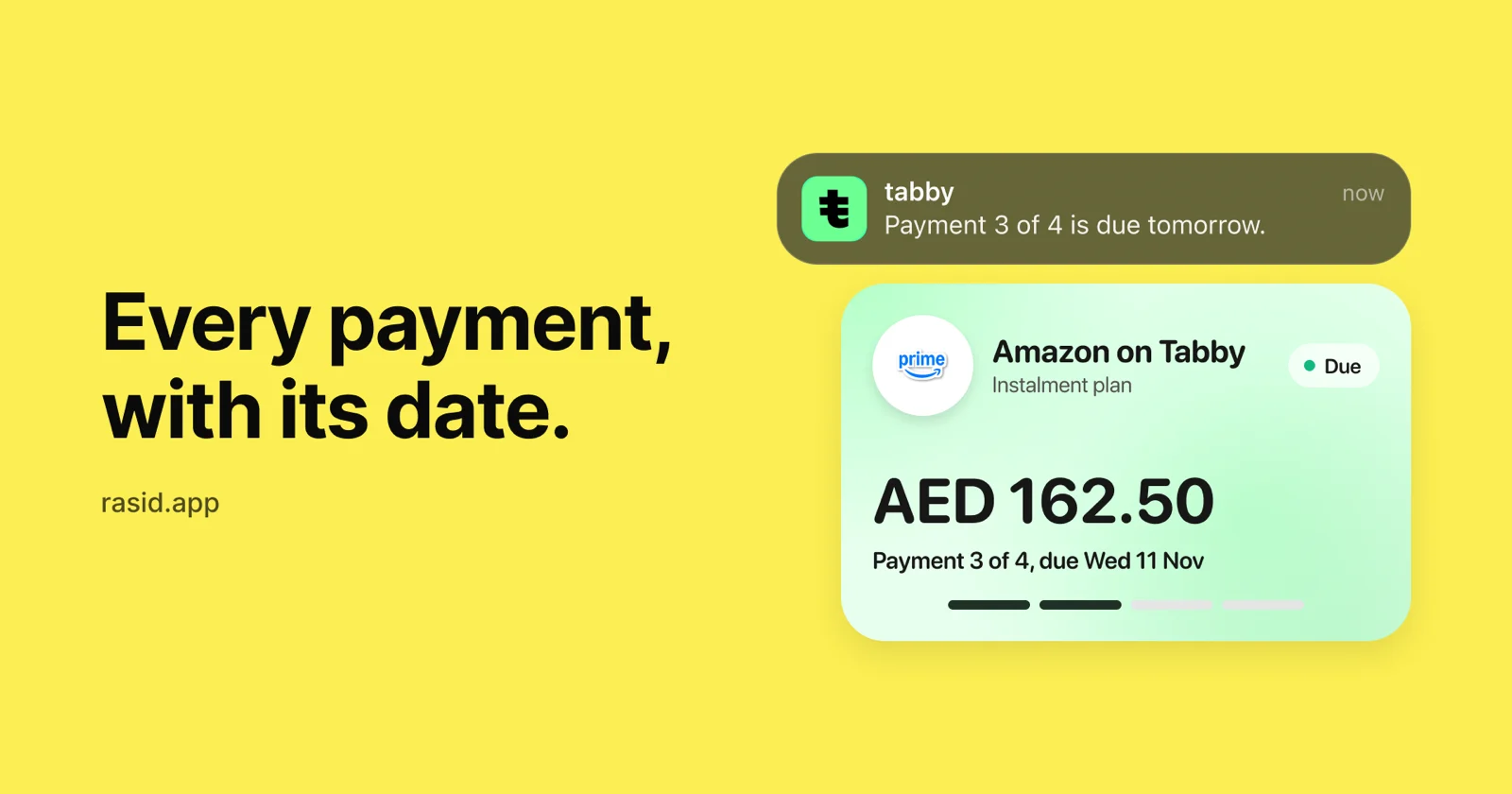
Each plan shows its payment count, for example "2 of 4 paid", the amount, the next payment date and the last, and "Paid off" once finished. Rasid reminds you three days before each payment, for example "Tabby: AED 150 for Amazon on 15 Nov". Home's monthly total includes the instalments due that month, labelled for example "Includes AED 845.00 of instalments", never the purchase price.
A payment day that has passed counts as paid only with proof, such as a receipt, a statement, Mark as paid, or the provider's own "charged on due date" message. Otherwise it reads "due, not confirmed". Rasid does not pay an instalment for you, and it never asks for a bank login.
For other things that renew on a schedule, see bills and subscriptions in one place and bill reminder apps in the UAE.
Sources
All read on 27 October 2026.
- Tabby, Pay in 4 (UAE): tabby.ai/en-AE/pay-in-4
- Tabby, fees help page (no date shown): tabby.ai/en-AE/help/help-get-started/are-there-any-fees-to-use-tabby
- Tamara, UAE: tamara.co/en-ae
- u.ae, Payment of wages (salaries due on the first): u.ae/en/information-and-services/jobs/Sector-of-employment/employment-in-the-private-sector/payment-of-wages
Rasid is independent and not affiliated with Tabby, Tamara or any provider named here.